
How old is my Carrier furnace, AC or heat pump?
Carrier, Bryant and Payne share one serial format, and Carrier has used it since the mid-1980s: the first two digits are the week and the next two are the year, followed by a plant letter. That puts the year in the third and fourth spots, which surprises a lot of people. Nine-digit all-number serials from the 1980s put the year first instead.
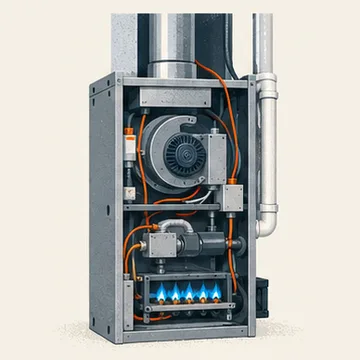
Condition matters more than the calendar. Rust, leaks, strange noises, rising bills or repeated repairs are reasons to act sooner. A clean, quiet, well-kept unit can outlast the range.
Read as: week and year, then a letter.
Warranty: Carrier covers parts for 10 years if the unit was registered within 90 days of installation, or 5 years if not. At about 7 years, it is covered only if it was registered (a few states waive registration). Coverage is for the original owner, and some registered gas furnaces carry a lifetime heat exchanger warranty. Check yours.
Carrier at a glance
| Where the date is | Week and year, then a letter (mid-1980s to today), plus 1 older or rarer style |
|---|---|
| How sure | Every style checked against two or more sources |
| Typical life | Furnace 15 to 20 years; central air conditioner 12 to 15 years; heat pump 10 to 15 years |
| Made by | Carrier Global, which also owns Bryant, Payne and the ICP brands |
| Parts warranty | 10 years if registered within 90 days of installation; 5 years if not |
| Recalls | 3 CPSC notices since 2000 (see below) |
Worked examples
Here is how the rule reads on sample serials in each style. Your own serial will have different digits in the same positions.
- Identify the style: week and year, then a letter (mid-1980s to today).
- Apply the rule: The first two digits are the week and the next two are the year. The letter in the fifth spot is a plant code.
- Result: built week 5 of 2019.
- Age as of November 2026: about 7 years old. A furnace typically lasts 15 to 20 years, so the verdict is: no need to replace it on age alone.
- Identify the style: nine digits, year and month (1980s).
- Apply the rule: On nine-digit all-number serials from the 1980s the first two digits are the year and the next two are the month.
- Result: built March 1985.
- Age as of November 2026: about 41 years old. A furnace typically lasts 15 to 20 years, so the verdict is: past its typical lifespan.
How to read a Carrier serial number
Week and year, then a letter (mid-1980s to today)
The first two digits are the week and the next two are the year. The letter in the fifth spot is a plant code.
0519E28045 reads as week 5 of 2019.
Two sources agree Building Intelligence Center, PickHVAC, Energy Trust of Oregon furnace chart, McGarry and Madsen Home Inspection
Nine digits, year and month (1980s)
On nine-digit all-number serials from the 1980s the first two digits are the year and the next two are the month.
850304091 reads as March 1985.
Two sources agree Building Intelligence Center, PickHVAC
Mistakes to avoid
- Reading the first two digits as the year. On Carrier they are the week; 0519 means week 5 of 2019.
- Reading the model number, which is longer and full of letters, instead of the serial.
Model number or serial number?
The model number describes the unit; the serial dates it. Carrier model numbers open with a two-digit family: 24 is an R-410A air conditioner, 25 an R-410A heat pump, 26 and 27 the R-454B versions, 58 an 80% furnace and 59 a 90%-plus furnace. On outdoor units, the 7th and 8th characters give the nominal cooling in thousands of Btu per hour. On furnaces, the 7th to 9th give the nominal input, so 060 means 60,000 Btu per hour. These are nominal: a 090 furnace is rated 88,000.
| Model number | What it tells you |
|---|---|
| 24TPA736W003 | R-410A air conditioner, two-stage Performance series; 36 = 3 tons; 3 = 208/230 volt single phase |
| 27SPA636A003 | R-454B heat pump, single-stage Performance series; 36 = 36,000 Btu/h (3 tons) |
| 59SC5B060E17-14 | 90%-plus gas furnace, single stage; 060 = 60,000 Btu/h input; 17.5-inch cabinet; 14 = 1,400 CFM |
Who makes Carrier
Carrier Global owns Carrier, Bryant and Payne, and the three share the serial format on this page. Carrier also owns International Comfort Products, whose brands include Heil, Tempstar, Comfortmaker, Arcoaire, KeepRite, Day & Night and Airquest. ICP equipment has its own serial styles, covered on the ICP page.
Carrier warranty
Register a Carrier within 90 days of installation and you choose 10 years of parts coverage, or 5 years of parts plus 3 years of labor through a participating dealer. Miss the 90 days and parts are covered for 5 years. Furnaces such as the Comfort 95 get a lifetime heat exchanger warranty when registered and 20 years when not, and some models add a 10-year unit replacement if the compressor fails. The terms are for the original owner, and where the law forbids tying coverage to registration, the longer terms apply.
These are Carrier's current terms. Terms change over the years, and the one that applies to you is the warranty in force when your unit was installed.
Check your warranty on Carrier's warranty lookup. Have the model and serial numbers ready.
Carrier recalls
These U.S. Consumer Product Safety Commission notices since 2000 name Carrier furnaces, central air conditioners or heat pumps. Most cover only certain models or build dates, so compare your model and serial with the notice before you worry.
- October 2019: Carrier and Bryant ductless heat pumps (fire hazard). 1.5-ton and 4-ton ductless outdoor units, models 38MGQC18, 38MGQF48 and 38MBQB48 (Carrier) and 538TEQ018, 538TEQ048 and 538REQ048 (Bryant).
- May 2017: Carrier Greenspeed and Bryant Evolution Extreme heat pumps (fire hazard). 2 to 5 ton heat pumps, models 25VNA024 to 25VNA060 (Carrier) and 280ANV024 to 280ANV060 (Bryant). The fix is a replacement fuse board.
- July 2001: Horizontal gas furnaces with NOx rods, sold in California (fire hazard). California only: horizontal gas furnaces with steel rods above the burners, made by Consolidated Industries and sold under Amana, Sunburst by Carrier, Goodman, Janitrol, Comfort-Aire, Trane, American Standard and other labels. The notice lists the models.
Room, window and hotel units, dehumidifiers and boilers are not part of this check. Check cpsc.gov/Recalls for those and for anything newer.
Carrier furnace
Typical life: 15 to 20 years
A gas furnace usually lasts 15 to 20 years. Well-maintained units in mild climates reach 25; units that run hard with dirty filters fail sooner.
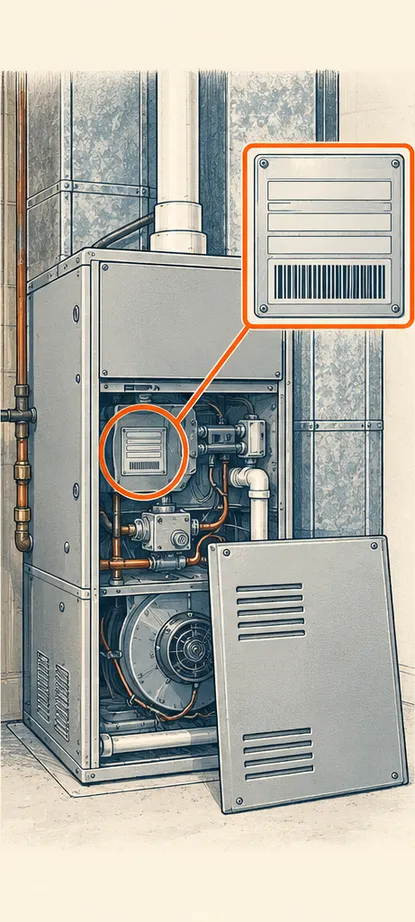
Where the serial is: Inside the front panel or on the side of the cabinet. Take the lower door off if you have to; the label is usually on the blower door or inside wall.
How long does a furnace last? · How to tell how old your furnace is · How much does a new furnace cost, and is a repair worth it?
Carrier central air conditioner
Typical life: 12 to 15 years
A central AC condenser usually lasts 12 to 15 years. In hot climates where it runs most of the year, 10 is more typical; in the north, 20 is possible.
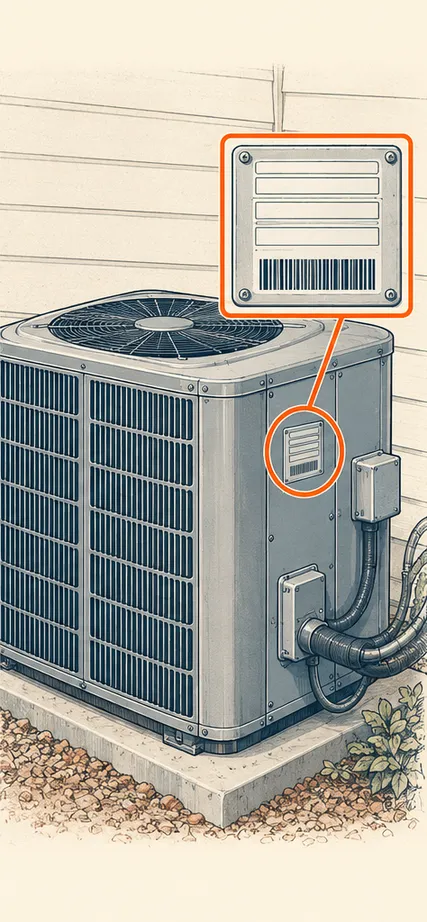
Where the serial is: On the data plate on the outdoor unit, usually near the electrical and refrigerant connections.
How long does a central air conditioner last? · How to tell how old your AC or heat pump is · What an AC or heat pump replacement costs, and when repair still wins
Carrier heat pump
Typical life: 10 to 15 years
An air-source heat pump usually lasts 10 to 15 years. It runs in both seasons, so it logs more hours than a furnace or an AC alone.
Where the serial is: On the data plate on the outdoor unit, near the line connections.
How long does a heat pump last? · How to tell how old your AC or heat pump is · What an AC or heat pump replacement costs, and when repair still wins
Carrier labels: Carrier puts the rating plate on the back of an air conditioner or heat pump, above the service valves. On a furnace it is on the inside of the front door panel, the blower door: turn the knobs on the door counterclockwise and pull the door toward you.
What refrigerant is in a Carrier AC or heat pump?
The data plate on the outdoor unit names the refrigerant. If the plate is faded, the build year narrows it down.
| Built | Usually | What it means |
|---|---|---|
| Before 2010 | R-22 or R-410A | From 2010 R-22 could no longer go into new equipment, and new R-22 production ended in 2020. Refills now come from recovered stock and cost more, but repairs are still allowed. |
| 2010 to 2024 | R-410A | Parts and refrigerant are easy to find. Units built before 2025 can still be installed new until stock runs out, under an EPA rule that took effect July 27, 2026. |
| 2025 on | A newer, lower-warming refrigerant | New systems built from January 1, 2025 moved to lower-warming refrigerants. The plate names which one. |
Trust the plate over this table. If yours uses R-22, read what an old R-22 system means now.
Questions
Where is the serial number on a Carrier furnace?
Inside the front panel or on the side of the cabinet. Take the lower door off if you have to; the label is usually on the blower door or inside wall. Use the line marked Serial No. or S/N, not Model No.
Where is the serial number on a Carrier central air conditioner?
On the data plate on the outdoor unit, usually near the electrical and refrigerant connections. Use the line marked Serial No. or S/N, not Model No.
Where is the serial number on a Carrier heat pump?
On the data plate on the outdoor unit, near the line connections. Use the line marked Serial No. or S/N, not Model No.
How sure is the date for a Carrier?
The Carrier rule on this page is confirmed by at least two independent sources. If the plate prints a manufacture date, that beats any decoded date.
How do I know which Carrier serial style I have?
Look at the shape of the serial. Week and year, then a letter (mid-1980s to today), for example 0519E28045; Nine digits, year and month (1980s), for example 850304091. The decoder tests every style and shows each reading that fits.
How long does a Carrier furnace last?
A typical furnace lasts 15 to 20 years. Upkeep, climate and how hard the unit works matter more than the brand.
Is my Carrier still under warranty?
If it was registered within 90 days of installation, Carrier covers parts for 10 years (or 5 years of parts plus 3 of labor); if not, 5. Coverage is for the original owner. Carrier's warranty lookup needs only the serial number.
How do I find the size of my Carrier AC from the model number?
On Carrier outdoor units the 7th and 8th characters give the nominal cooling in thousands of Btu per hour: in 24TPA736W003, 36 means 36,000 Btu/h, or 3 tons. The first two digits name the family, such as 24 for an R-410A air conditioner or 25 for an R-410A heat pump.
Has Carrier had recalls?
Yes. CPSC lists 3 recalls since 2000 that name Carrier furnaces, central air conditioners or heat pumps. Most cover specific models or build dates, so check the model and serial against each notice listed on this page.
Sources
- Building Intelligence Center
- PickHVAC
- Energy Trust of Oregon furnace chart
- McGarry and Madsen Home Inspection
- Carrier 26SCA5-02PD, 06/25
- Carrier 27SPA6-02PD, 08/25
- Carrier 24TPA7-03PD, 05/23
- Carrier 59SC5B-06PD, 08/21
- Carrier 58SC0A-05PD, 03/20
- Carrier corporate: HVAC segment brands
- ICP: Our Brands
- Carrier Warranty Registration and Information
- Carrier Comfort 24SCA5 AC page
- Carrier Comfort 95 furnace 59SC5
- Carrier Infinity 26 AC 24VNA6
- Carrier warranty lookup
- CPSC: Carrier and Bryant ductless heat pumps (fire hazard)
- CPSC: Carrier Greenspeed and Bryant Evolution Extreme heat pumps (fire hazard)
- CPSC: Horizontal gas furnaces with NOx rods, sold in California (fire hazard)
- EPA: What technicians and contractors need to know about phasing out HCFC refrigerants
- Contracting Business: EPA revises refrigerant rules, ends R-410A installation deadline
- NAHB: EPA finalizes refrigerant rule update to allow older HVAC unit installation
Serial rules last checked against their sources October 19, 2026. Warranty, model and recall details checked November 16, 2026. Found a date that doesn't match your label? Tell us.
Keep a record of your home
The age you just looked up is the kind of fact that gets lost. A written record of serial numbers, install dates, repairs and who did the work saves the next owner, inspector or insurer from guessing.

Keep This With the House
A lifetime logbook for the house, organized by system, with room for serial numbers, install dates, repairs and contractors.

The House Has Old Pipes
Galvanized, polybutylene, cast iron and the sewer line: what fails, what it costs and how to decide.

The House Is Fifty Years Old
A buyer's guide to older homes: wiring, pipes, lead, asbestos, insurance refusals and what the repairs cost.
Book links are Amazon affiliate links.