
How to tell how old your AC or heat pump is
The outdoor unit's data plate holds the serial, the refrigerant and the efficiency rating. Each one narrows the date.
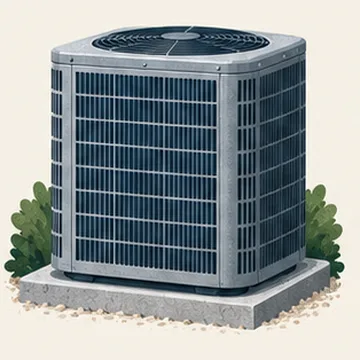
The outdoor half of a central air system takes the weather all year and does the hardest work, so it usually wears out first. ENERGY STAR suggests considering replacement for a heat pump or air conditioner more than 10 years old[10]. To know where yours stands, you need one label and about five minutes.
Find the data plate
Walk around the outdoor unit. The data plate is a printed sticker or riveted metal plate, usually on a corner panel near where the copper refrigerant lines and the electrical conduit enter. Shrubs, fences and years of sun can hide or bleach it, so bring a flashlight and take a photo.
The plate carries three things that help with dating:
- The serial number, which on most brands encodes the build date.
- The refrigerant type. EPA notes that most air conditioners have a nameplate identifying the refrigerant[1].
- The efficiency rating on some plates, or the model number, which the maker's literature ties to a SEER or SEER2 rating.
The indoor coil, air handler or furnace has its own label. Those parts are often replaced at different times from the outdoor unit, so decode each one separately rather than assuming they match.
Read the serial
Air conditioners and heat pumps use the same serial codes as the brand's furnaces. Carrier, Bryant and Payne put the week in the first two digits and the year in the next two[11]. Goodman and Amana lead with the year, then the month. Lennox and its sister brands start with a two-digit factory code, and the year sits in the third and fourth spots[12]. Trane and American Standard usually print MFG DATE on the plate outright.
- The plate says Carrier. Carrier serials since the mid-1980s are week, then year, then a plant letter.
- The first two digits, 05, are the week: the fifth week of the year, in early February.
- The next two, 19, are the year: 2019.
- In October 2026 that condenser is about 7 and a half years old, inside or below the typical range depending on whose figures you use.
Let the refrigerant narrow it down
Refrigerant rules changed three times in the last 20 years, and each change left a mark on the data plate.
R-22. EPA's phaseout schedule ended the use of new R-22 in equipment manufactured from January 1, 2010[2], and production and import of R-22 stopped entirely on January 1, 2020[1]. An R-22 plate usually means a unit built before 2010. The exception is "dry" condensing units, which were shipped without refrigerant and charged in the field for replacement jobs. Those kept R-22 condensers going into homes for a few years after the cutoff[3].
R-410A. R-410A was the standard refrigerant for new systems through the 2010s and early 2020s. Under EPA's Technology Transitions rule, new residential AC and heat pump systems made from January 1, 2025 must use a refrigerant with a global warming potential below 700, which rules R-410A out[4]. A rule finalized in May 2026 removed the deadline for installing R-410A equipment that was built or imported before 2025, so those units can be installed until supplies run out[5]. An R-410A plate tells you the unit was made before 2025, not that it was installed before then.
R-454B and R-32. These are the common replacements, both classed as mildly flammable (A2L)[4]. A unit charged with either was built for the 2025 rules and is almost certainly young.
Use the efficiency rating as a cross-check
Federal minimum efficiency standards set a floor for what could be sold:
| Period | Split-system AC minimum | Split heat pump minimum |
|---|---|---|
| From January 23, 2006 | 13 SEER | 13 SEER, 7.7 HSPF[6] |
| January 1, 2015 to December 31, 2022 | 13 SEER (14 in the Southeast and Southwest) | 14 SEER, 8.2 HSPF[7] |
| From January 1, 2023 | 13.4 SEER2 (14.3 in the South for most sizes) | 14.3 SEER2, 7.5 HSPF2[7] |
A plate or spec sheet that lists SEER2 points to a unit built for the 2023 rules. A 10 SEER unit predates 2006. Higher ratings could be bought in any year, so efficiency only sets a floor.
How long they last
InterNACHI's inspector chart gives central air conditioners 7 to 15 years and heat pumps 10 to 15[9]. Heat pumps tend to land at the shorter end in places where they heat and cool, because they run most of the year. Coastal air, cottonwood fluff, a dryer vent blowing on the coil and a unit that's too big for the house all shorten the life.
If the outdoor unit fails on an R-410A system, the condenser alone can still be replaced with an R-410A part; replacing both the indoor and outdoor parts together counts as a new system under the 2025 rules[8]. Ask the contractor which refrigerant the new equipment uses and whether the line set needs to change.
Mini-splits and the indoor half
Ductless mini-splits follow their own makers' codes. Some, like Mitsubishi Electric and LG, put a single year digit in the serial, which leaves the decade open; others print the manufacture date on the plate and put no date in the serial at all. The plate is the first place to look on any mini-split.
For a central system, it's worth decoding the indoor coil or air handler too. If the outdoor unit was replaced alone after a failure, the coil may be years older, and a coil leak on an old system is often what ends it. The indoor label is usually on the side of the air handler or on the coil cabinet above the furnace.
Common mistakes
- Assuming R-22 always means pre-2010. Dry-shipped R-22 condensers were installed after that date.
- Assuming R-410A means installed before 2025. Older stock can still be installed.
- Dating the outdoor unit from the furnace label. Indoor and outdoor parts are replaced on different schedules.
- Taking SEER as a date. It sets a floor, not a year.
- Reading the Lennox factory code as the year. The year starts at the third digit.
Decode yours
Type the outdoor unit's serial into the decoder, pick the brand, and choose air conditioner or heat pump. If your plate lists R-22, read what R-22 means now before you pay for another refill.
Frequently asked questions
Where is the serial number on an AC unit?
On the data plate on the outdoor condenser, usually on a side panel near where the refrigerant lines and electrical whip connect. The indoor coil or air handler has its own separate label.
Does R-22 on the label mean my AC was built before 2010?
Usually, but not always. New R-22 systems couldn't be made from January 1, 2010, yet dry-shipped condensers that were charged in the field kept R-22 units going into homes for a few years after.
My AC says R-410A. Was it installed before 2025?
Not necessarily. EPA removed the January 1, 2026 installation deadline in May 2026, so R-410A equipment made before 2025 can still be installed until stocks run out.
What does SEER2 on the label tell me?
The SEER2 rating replaced SEER on January 1, 2023. A label that lists SEER2 is from a unit built for the 2023 standards.
Can I find the age without going outside?
Sometimes. The indoor air handler or furnace label is easier to reach, but it dates only that part. The outdoor unit is usually the one that matters most for replacement planning.
Sources
- U.S. EPA, Residential Air Conditioning and the Phaseout of HCFC-22 (PDF)
- U.S. EPA, Phaseout of Class II Ozone-Depleting Substances
- ACHR News, R-22 phaseout: the long goodbye
- Rheem, 2024 A2L regulatory guide (PDF)
- ACHR News, EPA removes R-410A installation deadline
- Federal Register, 66 FR 7170 (January 22, 2001), central air conditioner standards
- eCFR, 10 CFR 430.32, Energy and water conservation standards
- HARDI, EPA publishes final Technology Transitions rule
- InterNACHI, Standard Estimated Life Expectancy Chart for Homes
- ENERGY STAR, When to replace heating and cooling equipment
- Building Intelligence Center, Carrier HVAC age
- Building Intelligence Center, Lennox HVAC age
Keep a record of your home
The age you just looked up is the kind of fact that gets lost. A written record of serial numbers, install dates, repairs and who did the work saves the next owner, inspector or insurer from guessing.

Keep This With the House
A lifetime logbook for the house, organized by system, with room for serial numbers, install dates, repairs and contractors.

The House Has Old Pipes
Galvanized, polybutylene, cast iron and the sewer line: what fails, what it costs and how to decide.

The House Is Fifty Years Old
A buyer's guide to older homes: wiring, pipes, lead, asbestos, insurance refusals and what the repairs cost.
Book links are Amazon affiliate links.