
How long does a furnace last?
A gas furnace usually lasts 15 to 20 years. Well-maintained units in mild climates reach 25; units that run hard with dirty filters fail sooner.
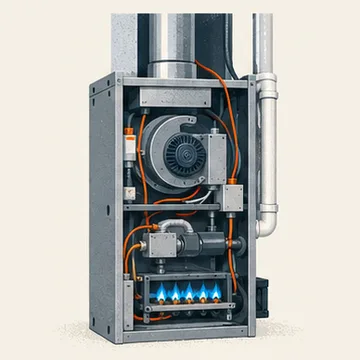
A gas furnace usually lasts 15 to 20 years. Well-maintained units in mild climates reach 25; units that run hard with dirty filters fail sooner.
A furnace is a burner, a heat exchanger, a blower and a set of controls. The heat exchanger is the part that decides when the furnace is done: it is a metal chamber that heats and cools thousands of times a season, and when it cracks, combustion gases can leak into the house air. A cracked heat exchanger on a furnace past its mid-teens is almost always a replace, not a repair.
Blower motors, igniters, flame sensors, pressure switches and control boards fail more often but are ordinary repairs. The question with each repair is the age of the unit around it. Industry guides and manufacturers put the typical life at 15 to 20 years, with 25 at the top end.
Filter habits set the pace. A clogged filter starves the blower and overheats the heat exchanger, which is the fastest way to shorten a furnace's life. High-efficiency condensing furnaces (90%+ AFUE) also have a secondary heat exchanger and a condensate drain that add two more things that can fail.
How old is too old? A quick table
Each row compares a build year with the typical 15-to-20-year range. Condition matters more than the calendar: a well-kept unit can outlast the range, and one with rust, leaks or repeated repairs may not reach it.
| Built in | Age in 2026 | Where it stands |
|---|---|---|
| 2026 | about 0 years | No need to replace it on age alone |
| 2023 | about 3 years | No need to replace it on age alone |
| 2020 | about 6 years | No need to replace it on age alone |
| 2017 | about 9 years | No need to replace it on age alone |
| 2014 | about 12 years | No need to replace it on age alone |
| 2011 | about 15 years | In the usual replacement window |
| 2008 | about 18 years | In the usual replacement window |
| 2005 | about 21 years | Past its typical lifespan |
| 2002 | about 24 years | Past its typical lifespan |
How to make it last longer
- Change the filter every 1 to 3 months during the heating season.
- Have the burners, flame sensor and heat exchanger inspected each fall.
- Keep the condensate drain clear on a high-efficiency furnace.
- Keep supply and return vents open so the blower is not fighting the ductwork.
When to replace it
Replace it if the heat exchanger is cracked, if it is past 15 to 20 years and needs a major part, or if a repair would cost more than a third of a new furnace. Replace a working furnace early only if the efficiency gain is large and you will stay long enough to collect it.
Replace it now if
- A technician has found a cracked or rusted-through heat exchanger. It is a carbon monoxide risk and it is not a repair on an older unit.
- It is 20 or more years old and needs a blower motor, control board or gas valve.
- It shuts off on its own high-limit switch repeatedly after the filter and vents are cleared.
- Repairs are becoming yearly events and each one is a few hundred dollars.
Repair it if
- It is under 12 years old and the fault is an igniter, flame sensor, pressure switch, capacitor, inducer motor or thermostat. These are routine.
- It is older but the problem is the thermostat, the filter, a dirty flame sensor or a tripped safety.
- A high-efficiency furnace is shutting down because the condensate drain is blocked. Clear it.
Use the one-third rule
If the repair costs more than a third of a new installed furnace and the unit is past 12 to 15 years, replace. Under that, repair. Add the fuel bill to the math: a 1990s furnace at 78% to 80% AFUE replaced by a 95%+ unit saves about 15 to 18 cents on every heating dollar. In a cold climate that can be several hundred dollars a year; in a mild one it is not enough to justify replacing a working furnace on its own.
What replacement involves
Size matters more than brand. A new furnace should be sized from a load calculation, not matched to the old nameplate, because insulation and windows have usually changed since the house was built. A high-efficiency furnace vents through PVC pipe to the side of the house and needs a condensate drain; that is normal. If you also have an aging central AC on the same blower, replacing both at once is cheaper than two separate jobs.
Carbon monoxide
Any gas furnace past 15 years should have a working CO alarm on each level of the house. If an alarm sounds, leave and call the gas utility or fire department. Do not wait to decide about replacement.
More on this: How much does a new furnace cost, and is a repair worth it? · How to tell how old your furnace is · How long does a heat pump last?
How old is yours?
Inside the front panel or on the side of the cabinet. Take the lower door off if you have to; the label is usually on the blower door or inside wall. Then pick the brand: Rheem · Ruud · Goodman · Amana (heating and cooling) · Daikin · Carrier · Bryant · Payne · Day & Night · Heil / Tempstar / Comfortmaker / Arcoaire / KeepRite · Lennox · Armstrong Air / AirEase / Concord / Allied · Ducane · Aire-Flo · Trane · American Standard (heating and cooling) · York · Luxaire · Coleman / Evcon · Fraser-Johnston / Champion / Guardian · WeatherKing · Nordyne / Intertherm / Miller / Maytag / Frigidaire / Tappan / Westinghouse / Kelvinator / Gibson / Broan · Comfort-Aire / Heat Controller / Century.
Get free local pricing on heating and cooling replacement
Comparing local prices is the easiest way to decide whether to repair or replace your heating and cooling system.
Call (213) 953-5723Free call. You will be asked for your 5-digit ZIP code, then connected to a local company. Stay on the line, because it can take a few seconds to connect. The company that answers is an independent partner, and this site may be paid a fee for the call. You are never obliged to hire anyone.
Sources
Keep a record of your home
The age you just looked up is the kind of fact that gets lost. A written record of serial numbers, install dates, repairs and who did the work saves the next owner, inspector or insurer from guessing.

Keep This With the House
A lifetime logbook for the house, organized by system, with room for serial numbers, install dates, repairs and contractors.
The House Has Old Pipes
Galvanized, polybutylene, cast iron and the sewer line: what fails, what it costs and how to decide.
The House Is Fifty Years Old
A buyer's guide to older homes: wiring, pipes, lead, asbestos, insurance refusals and what the repairs cost.
Book links are Amazon affiliate links.