
How much does a new furnace cost, and is a repair worth it?
What a new furnace costs, what common repairs cost, and simple math for the repair-or-replace call.
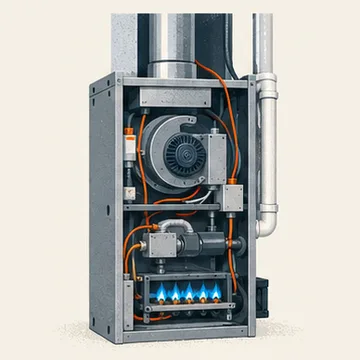
Furnaces rarely die without warning. They limp: an igniter here, a blower motor there, a service call every winter. The hard part is knowing when the next repair stops making sense. That comes down to two numbers you can get today, the age of the furnace and the cost of the repair in front of you.
What a new furnace costs
National surveys put installed prices in these ranges. They are estimates from contractor data, and Angi and HomeAdvisor share a data source, so treat their figures as one view rather than two.
| Furnace type | Installed range |
|---|---|
| Electric | $2,000 to $7,000[1][2] |
| Natural gas | $3,800 to $10,000, up to about $12,000[1][2] |
| Propane | $3,700 to $14,200[2] |
| Oil | $6,750 to $10,000 and up[1][2] |
Removing the old unit adds $60 to $330[1]. Within a fuel type, the biggest swing comes from efficiency and blower type. PickHVAC estimates a single-stage 95% furnace costs $500 to $750 more than an 80% unit, and a two-stage variable-speed 95% model $900 to $1,200 more[3]. Going from 80% to 95% for the first time also means new side-wall PVC venting, roughly $200 to $500, and a condensate drain, about $250 if one has to be added[3].
One cost people miss: when an 80% furnace that shared a chimney with a gas water heater is replaced by a 95% unit, the water heater is left venting alone into a chimney sized for two appliances. Contractor Magazine explains that this "orphaned" water heater can backdraft or soak the chimney in acidic condensation, and the fix is a properly sized liner or a different water heater[15]. Ask about it before you sign.
What common repairs cost
HomeAdvisor's 2026 figures put the average furnace repair at $318[4]. By part:
| Repair | Typical cost[4] | Notes |
|---|---|---|
| Flame sensor | $150 to $250 | Often just needs cleaning |
| Igniter | $150 to $500 | A wear part; fails every several years |
| Control board | $200 to $600 | |
| Gas valve | $200 to $600 | |
| Inducer motor | $200 to $1,500 | Wide range by model |
| Blower motor | $150 to $2,000 | Variable-speed motors cost the most |
| Heat exchanger | $100 to $1,500 | Often the reason to replace instead |
Two rules of thumb
The $5,000 rule. Multiply the furnace's age by the repair quote. If the result is over $5,000, lean toward replacing. Bryant describes it as a commonly used industry guideline and adds that a repair over $1,000 on a unit 13 to 15 or more years old points toward replacement[5]. CBS News, explaining the same rule, calls it simply a starting point[7]; nobody seems to know who came up with it.
The 50% rule. Trane suggests replacing when a repair costs near or above half the price of a new system, repairing freely in the first five years and considering replacement after 15[6].
- $5,000 rule: 16 × $650 = $10,400. Well over $5,000.
- 50% rule: against a $5,500 gas furnace replacement, $650 is about 12%. Under the line.
- The rules disagree, which is common. Age breaks the tie: at 16 the furnace is inside the 15-to-20-year life Bryant gives most furnaces[5], and Trane suggests considering replacement past 15[6].
- A reasonable call: make the repair if it gets you through this winter, and get replacement quotes now so the next failure isn't an emergency.
When the heat exchanger cracks
The heat exchanger separates the burner flame from the air the blower sends through your house. A crack or hole lets combustion gases into that air. In one investigation by British Columbia's safety regulator, a holed heat exchanger produced carbon monoxide readings of 500 ppm in a home and sent a person to the hospital[14].
The U.S. Consumer Product Safety Commission urges a yearly professional inspection of furnaces, flues and vents, and says every home should have a carbon monoxide alarm[13]. On a furnace past its mid-teens, a confirmed cracked heat exchanger is almost always a replacement rather than a repair: the part is expensive, labor is heavy, and everything around it is just as old.
Efficiency rules and credits
The federal minimum for a non-weatherized gas furnace is 80% AFUE[8]. DOE finalized a rule requiring 95% for furnaces made from December 18, 2028[9], but the Supreme Court vacated the appeals decision upholding it in June 2026 and the case is being reheard[10], and DOE has asked for comment on a petition to delay compliance to 2030 or later[11]. Ask your installer what's current where you live.
For an ENERGY STAR gas furnace, the bar is 97% AFUE in northern states and 95% in the south[12]. The federal 25C tax credit that used to cover part of the cost ended for equipment placed in service after December 31, 2025[16]. Utility rebates may still apply.
Getting a good quote
Furnace quotes vary as much in what they include as in price. Ask each contractor the same questions:
- Did you size it, or match the old one? Many older furnaces were oversized. A load calculation for the house, not the old nameplate, should set the size.
- What's the exact model and AFUE? Write both down so you can compare like with like.
- What happens to the venting? A 95% furnace vents through PVC. An 80% furnace may need a chimney liner. Either way, what happens to the water heater that shares the flue?
- Is the AC coil affected? A new furnace can change the cabinet height or width under an existing coil.
- What's included? Permit, removal, thermostat, filter rack and condensate drain.
If two quotes for the same equipment are thousands apart, the answers to these questions usually explain why.
Common mistakes
- Treating the $5,000 rule as the answer. It's a prompt to think, not a verdict.
- Forgetting the venting and drain on a first 95% furnace. They belong in the quote.
- Ignoring the water heater on a shared chimney. It can be left unsafe.
- Skipping the yearly inspection. It is how cracked heat exchangers get found.
- Running a home without a CO alarm. CPSC says every home should have one.
Start with the age
Both rules need the furnace's age. Decode the serial with the decoder, or see how to tell how old your furnace is.
Frequently asked questions
What is the $5,000 rule for furnaces?
Multiply the furnace's age in years by the repair quote. If the result is over $5,000, replacement is usually the better deal. Bryant calls it a commonly used industry guideline; treat it as a starting point, not a verdict.
Is there a tax credit for a new furnace in 2026?
No. The federal 25C credit, which covered up to $600 for an efficient gas furnace, does not apply to anything placed in service after December 31, 2025.
How much more does a 95% furnace cost than an 80% one?
PickHVAC estimates $500 to $750 more for a single-stage 95% unit, or $900 to $1,200 more for a two-stage variable-speed model, plus a few hundred dollars for PVC venting and a condensate drain if the house doesn't have them.
Is a cracked heat exchanger dangerous?
It can be. A crack can let combustion gases, including carbon monoxide, into the air the blower moves through the house. A furnace with a confirmed crack should be shut down until it's dealt with, and every home should have working CO alarms.
How long does a furnace last?
Bryant says most furnaces last 15 to 20 years. Filter habits, climate and the condition of the heat exchanger decide where yours lands.
Get free local pricing on heating and cooling replacement
Comparing local prices is the easiest way to decide whether to repair or replace your heating and cooling system.
Call (213) 953-5723Free call. You will be asked for your 5-digit ZIP code, then connected to a local company. Stay on the line, because it can take a few seconds to connect. The company that answers is an independent partner, and this site may be paid a fee for the call. You are never obliged to hire anyone.
Sources
- HomeAdvisor, Furnace installation cost (updated June 17, 2026)
- Angi, How much does a new furnace cost? (updated September 8, 2026)
- PickHVAC, 80% vs 95% furnace (June 3, 2025)
- HomeAdvisor, Furnace repair cost (updated June 20, 2026)
- Bryant, Furnace replacement
- Trane, Repair or replace
- CBS News, What is the $5,000 rule for HVAC systems? (June 24, 2026)
- eCFR, 10 CFR 430.32, Energy and water conservation standards
- U.S. DOE, Consumer furnaces rulemaking
- ACHR News, 95% furnace efficiency rule to get new hearing
- Federal Register, DOE petition notice on furnace compliance date (April 27, 2026)
- ENERGY STAR, Furnaces key product criteria
- U.S. CPSC, Home Heating Equipment and carbon monoxide
- Technical Safety BC, Cracked heat exchanger incident investigation
- Contractor Magazine, Orphaned water heaters and flue liners
- IRS, Energy credits FAQs (FS-2025-05)
Keep a record of your home
The age you just looked up is the kind of fact that gets lost. A written record of serial numbers, install dates, repairs and who did the work saves the next owner, inspector or insurer from guessing.

Keep This With the House
A lifetime logbook for the house, organized by system, with room for serial numbers, install dates, repairs and contractors.
The House Has Old Pipes
Galvanized, polybutylene, cast iron and the sewer line: what fails, what it costs and how to decide.
The House Is Fifty Years Old
A buyer's guide to older homes: wiring, pipes, lead, asbestos, insurance refusals and what the repairs cost.
Book links are Amazon affiliate links.