
How to tell how old your water heater is
Find the label, read the serial for your brand, and check the date against the label's other clues.
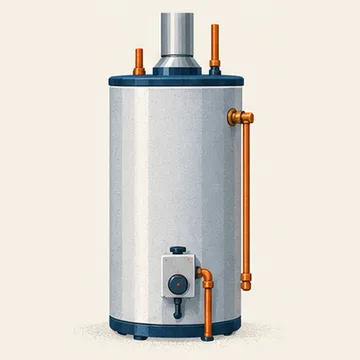
A tank water heater rarely announces that it is about to quit. It works fine on Tuesday and leaves a puddle on Wednesday. Knowing the build year is the closest thing to a warning you get, because age is the best single predictor of a tank failure. ENERGY STAR suggests thinking about replacement once a water heater passes 10 years[12].
The good news is that the date is almost always on the unit. It is just written in code.
Find the label
Every water heater carries a rating label, a printed sticker or metal plate with the model number, serial number, capacity, fuel and input rating. On a tank it is on the side, usually at about eye level and often next to the yellow EnergyGuide sticker. On a tankless unit it is on the side or bottom of the cabinet, or under the front cover.
Take a photo of the whole label with your phone before you do anything else. Basement light is bad, labels are often upside down from where you're standing, and a photo lets you zoom in on faded characters later.
The line you want says Serial No., S/N or Ser. The model number sits right next to it and is the most common thing people decode by mistake. The model number describes the product line and is the same on thousands of tanks; the serial is unique to yours.
Read the serial for your brand
There is no industry standard. Each maker chose its own way to hide the date, and several changed their scheme over the years. Most fall into a handful of families.
| Family | Brands | How the date is written | Example |
|---|---|---|---|
| Month, then year | Rheem, Ruud, Richmond, GE (older), Marathon | Skip any letters at the start. The next two digits are the month and the two after that are the year[2][3]. | 1209D01234 = December 2009 |
| Year, then week | A.O. Smith (current), American, Whirlpool, State and Reliance (newer) | The first two digits are the year and the next two are the week of the year[3][4]. | 1210A002243 = week 10 of 2012 |
| Year, then month | GSW, John Wood | Year first, then month: the reverse of Rheem[3]. | 8901 = January 1989 |
| Letters for year and month | Bradford White | The first letter is the year, the second is the month. Year letters repeat every 20 years[5][6]. | HK... = November of 1994 or 2014 |
| Month letter, then year | Older A.O. Smith and State | A letter stands for the month (A is January) followed by two digits of year[3]. | AJ89 = October 1989 |
Tankless heaters have their own habits. Rinnai units made since 2009 start with a year letter (A for 2009) and a month letter; earlier Rinnai serials use digits for year and month[7]. Navien puts a year, a month character and a day in the middle of the serial, with X, Y and Z standing for October, November and December[8]. Noritz writes the full four-digit year, a period and the month.
Store brands follow whoever built the tank. InterNACHI's chart lists GE, Richmond, Ruud and Marathon on Rheem's month-then-year format[3], while Whirlpool and many house brands use American Water Heater's year-and-week code. If the name on the front isn't a company you've heard of as a manufacturer, the serial is probably borrowed from one of the big three.
- The label says A.O. Smith and the serial starts with four digits, so this is the current year-and-week style.
- The first two digits, 12, are the year: 2012.
- The next two, 10, are the week: the tenth week of 2012, which falls in early March.
- In October 2026 that tank is about 14 and a half years old, past the 8-to-12-year range most tanks reach.
Check the date against the label's other clues
A decoded date should agree with everything else on the label. When it doesn't, or when the serial could mean more than one year, these details narrow it down.
The ANSI or CSA standard year. Labels list the safety standard the tank was certified to, written like ANSI Z21.10.1a-1985. That year is the edition of the standard, not the build date. It only proves the tank is no older than 1985[5]. It is still useful for a Bradford White, where the year letters repeat every 20 years: if the standard edition is from 2011, a letter that could mean 1994 or 2014 has to mean 2014.
UEF versus EF. Water heater efficiency ratings switched from Energy Factor (EF) to Uniform Energy Factor (UEF) in June 2017[10]. A label that shows a UEF number is from mid-2017 or later.
The tank's size and shape. Federal efficiency standards that took effect on April 16, 2015 added insulation to most tanks, and many models grew an inch or two taller or wider as a result[9]. A noticeably slim tank next to a new one of the same capacity is likely from before 2015.
Paperwork and permits. Replacing a water heater normally takes a plumbing permit. Many cities, Portland among them, let you search past permits online by address[13], which gives you an install date even when the serial won't give you a build date.
The manufacturer. Every maker can date its own serials. Bradford White runs an online lookup where you type the serial and get the date[6]. For other brands, call customer service with the model and full serial ready.
What the age means
Lifespan estimates vary by source. The Department of Energy puts storage tanks at 10 to 15 years, tankless units at about 20 and heat pump water heaters at 10 to 15[1]. InterNACHI's inspector chart is more cautious: 6 to 12 years for a tank and about 10 for tankless[11]. Where yours lands depends mostly on water quality and whether anyone has ever flushed the tank or changed the anode rod.
Use the age as a planning number. A 5-year-old tank with a failed thermostat is worth fixing. A 13-year-old tank with the same problem is a reason to get a replacement price, because the next failure is likely to be the tank itself, and tanks fail by leaking.
Common mistakes
- Decoding the model number. It sits right next to the serial and often contains digits that look like a year.
- Using one brand's rule on another. Rheem writes month then year; GSW writes year then month. The same four digits mean different dates.
- Picking the wrong Bradford White cycle. A letter can mean two years 20 years apart. A rusty, crusted tank is the older one.
- Treating the ANSI year as the build year. It is a floor, not a date.
- Reading a week number as a month. On year-and-week serials, a 36 in the third and fourth spots means early September, not an error.
If the decoder can't read it
Some serials simply don't carry a date. A few tankless brands use plain sequence numbers, and the decoder will say so rather than guess. For those, the no-date-code page covers the other places to look. For everything else, type the serial into the decoder: it tests every format for the brand you pick and shows every reading that fits.
Frequently asked questions
Is the date on the ANSI line the age of my water heater?
No. The ANSI or CSA standard year shows the edition of the safety standard the tank was certified to. It tells you the tank can't be older than that year, nothing more.
Can the manufacturer tell me how old my water heater is?
Yes. Every maker can date its own serials. Bradford White has an online lookup, and other brands will date a unit by phone if you give them the model and full serial.
Does the serial number show the install date?
No, only when the tank was built. Most tanks are installed within months of manufacture, but a permit or invoice is the only way to know the install date.
My tank is a store brand. Which rule do I use?
The rule of the company that built it. Kenmore, GE, Whirlpool and similar names were made by Rheem, American Water Heater or A.O. Smith, and the serial follows the factory.
Sources
- U.S. Department of Energy, Which Water Heater Is Right for You?
- Rheem, How to locate and read your Rheem water heating serial numbers
- InterNACHI, Water Heater Dating Chart
- Building Intelligence Center, A.O. Smith water heater age
- Building Intelligence Center, Bradford White water heater age
- Bradford White, Frequently Asked Questions
- Building Intelligence Center, Rinnai water heater age
- Building Intelligence Center, Navien water heater age
- ACEEE, Water Heaters consumer guide
- Richmond Water Heaters, What is UEF?
- InterNACHI, Standard Estimated Life Expectancy Chart for Homes
- ENERGY STAR, When should you replace your water heater?
- City of Portland, Residential plumbing permits
Keep a record of your home
The age you just looked up is the kind of fact that gets lost. A written record of serial numbers, install dates, repairs and who did the work saves the next owner, inspector or insurer from guessing.

Keep This With the House
A lifetime logbook for the house, organized by system, with room for serial numbers, install dates, repairs and contractors.

The House Has Old Pipes
Galvanized, polybutylene, cast iron and the sewer line: what fails, what it costs and how to decide.

The House Is Fifty Years Old
A buyer's guide to older homes: wiring, pipes, lead, asbestos, insurance refusals and what the repairs cost.
Book links are Amazon affiliate links.