
How to tell how old your furnace is
Open the right panel, find the label, and read the date the way your brand writes it.
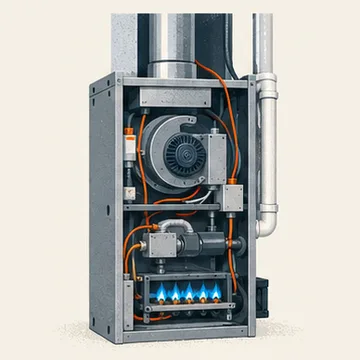
A furnace usually gives more warning than a water heater. It gets louder, cycles oddly, or needs the same repair twice. Its age is what turns those symptoms into a decision. ENERGY STAR suggests considering replacement for a furnace or boiler more than 15 years old[12], and the answer to "repair or replace" almost always starts with the build year.
Find the data label
Turn the furnace off at its service switch or breaker before you open any panel. Most furnaces have an upper door over the burners and a lower door over the blower, held on by tabs or a couple of screws.
The label is almost always inside. Goodman's own instructions are typical: on its 80% furnaces the model and serial label is on the left inner wall behind the top door, and on 90% furnaces it is on the inside of the bottom access door[1]. Other makers use the blower door, the inside of the cabinet wall, or a plate on the side of the cabinet.
Look for a printed sticker with columns of small type and a barcode. You want the line marked Serial No. or S/N. Some labels also print a manufacture date, often written MFG DATE. If you see one, you're done; it beats any decoded date.
How the main brands write the date
Furnace makers each picked their own code, and the codes look nothing alike. Here are the big ones.
| Brand | Where the date is | Example |
|---|---|---|
| Carrier, Bryant, Payne | First two digits are the week, next two are the year[2]. | 4006A17330 = week 40 of 2006 |
| Goodman, Amana (since 1997), Daikin (since 2012) | First two digits are the year, next two the month[3]. | 1503... = March 2015 |
| Lennox and its brands | First two digits are a plant code. The year is the third and fourth digits, followed by a month letter[4]. | 5899L17212 = 1999 |
| Trane, American Standard | Usually printed as MFG DATE. Serials from 2010 start with year and week; 2002 to 2009 start with one year digit and the week; 1983 to 2001 start with a year letter[5]. | 10161KEDAA = week 16 of 2010 |
| Rheem, Ruud | Several formats. Older units hide the week and year after a single letter in the middle of the serial[6]. | ...F0999... = week 9 of 1999 |
| York, Luxaire, Coleman | Since 2004, the second and fourth characters form the year and the third is a month letter. Before that, letters coded both month and year[7]. | W0K5896070 = 2005 |
The Carrier and Lennox codes cause most of the confusion, because both put two digits in front that are not the year. Building Intelligence Center points out that Carrier's week-first serial is easy to mistake for a Lennox serial and vice versa[2]. Check the brand on the label before you start counting.
- The label says Lennox, so the first two digits, 58, are the factory code. Skip them.
- The next two digits, 98, are the year: 1998.
- The letter after them, G, is the month. Lennox month letters run A for January through M for December, skipping I, so G is July.
- Built July 1998, the furnace was about 28 years old in October 2026, past the top of InterNACHI's 15-to-25-year range[11].
What the efficiency rating says about its era
A furnace's design is a rough clock even before you decode anything. The Department of Energy describes three generations[8]:
- Older units run at 56 to 70% AFUE and use a continuous pilot light. DOE calls gas furnaces with pilot lights strong candidates for replacement.
- Mid-efficiency units run at 80 to 83% and light the burner electronically, with an exhaust fan instead of a natural draft.
- High-efficiency condensing units run at 90 to 98.5%. They have a second heat exchanger, a condensate drain and usually white plastic vent pipes out the side of the house.
Federal minimums tell you what could be sold when. The floor for non-weatherized gas furnaces was 78% AFUE before November 19, 2015, and 80% after[9]. Those are minimums only; a high-efficiency unit could be bought in any year, so efficiency narrows the range but doesn't date the unit by itself.
The next step up is in dispute. The rule in the federal code requires non-weatherized gas furnaces built from December 18, 2028 to reach 95% AFUE[9]. In June 2026 the Supreme Court vacated the appeals court decision that had upheld that rule and sent the case back for another look[10], and DOE has asked for comment on a petition to push the compliance date to 2030 or later[13]. If you're deciding between an 80% and a 95% furnace, ask your installer what's current where you live.
How old is too old
InterNACHI puts typical furnace life at 15 to 25 years[11]. The heat exchanger usually sets the limit. It expands and contracts thousands of times a season, and a crack can let combustion gases into the air the blower moves through your house. Blower motors, igniters, flame sensors and control boards fail more often but are ordinary repairs.
Age changes how you weigh those repairs. A $600 control board on a 6-year-old furnace is an easy yes. The same board on a 19-year-old furnace buys you time, not reliability. The furnace cost guide covers the repair-or-replace math in detail.
Common mistakes
- Reading the Lennox plant code as the year. A serial starting 58 is not from 1958.
- Reading Carrier's week as a month. On Carrier, Bryant and Payne the first two digits run up to 52.
- Treating a 2002 to 2009 Trane serial as a two-digit year. In that era only the first digit is the year.
- Assuming the AC is the same age. The outdoor unit and indoor coil are often replaced separately. Decode each.
- Using efficiency as an exact date. An 80% furnace was legal to build after 2015, and a 95% one could be bought in 1995.
Decode yours
Pick the brand and type the serial into the decoder. It knows every format listed here plus the older styles for each brand, and it shows every reading that fits instead of guessing.
Frequently asked questions
Is the furnace serial number on the outside of the cabinet?
Sometimes, but usually not. Most makers put the label inside the access panel. Goodman, for example, puts it on the left inner wall of 80% furnaces and on the inside of the bottom door on 90% furnaces.
My furnace has a standing pilot light. How old is it?
Probably old. Continuous pilot lights belong to the 56 to 70% efficiency furnaces that predate electronic ignition. That alone doesn't give a year, but it points to a unit from the 1990s or earlier.
Are 80% furnaces being banned?
A federal rule requires new non-weatherized gas furnaces built from December 18, 2028 to reach 95% AFUE. The rule is back in court after a June 2026 Supreme Court order, and DOE is considering a petition to delay it, so check the date before you plan around it.
Does the furnace age match the AC age?
Not necessarily. The furnace, the indoor coil and the outdoor unit are often replaced at different times. Decode each label separately.
Can I find my furnace age from the model number?
Rarely. The model number tells you the product line, size and efficiency. The build date is in the serial number or printed as a separate MFG DATE line.
What if the label has faded or is missing?
Look for service stickers, a permit or invoice, and the furnace's design clues: pilot light versus electronic ignition and metal versus plastic vent pipe. The no-date-code page lists other ways to estimate age.
Sources
- Goodman, Furnace serial and rating label locations (PDF)
- Building Intelligence Center, Carrier HVAC age
- Building Intelligence Center, Goodman HVAC age
- Building Intelligence Center, Lennox HVAC age
- Building Intelligence Center, Trane HVAC age
- Building Intelligence Center, Rheem HVAC age
- Building Intelligence Center, York HVAC age
- U.S. Department of Energy, Furnaces and Boilers
- eCFR, 10 CFR 430.32, Energy and water conservation standards
- Contracting Business, Supreme Court vacates ruling on 95% furnace efficiency standard (June 9, 2026)
- InterNACHI, Standard Estimated Life Expectancy Chart for Homes
- ENERGY STAR, When to replace heating and cooling equipment
- Federal Register, DOE petition notice on furnace compliance date (April 27, 2026)
Keep a record of your home
The age you just looked up is the kind of fact that gets lost. A written record of serial numbers, install dates, repairs and who did the work saves the next owner, inspector or insurer from guessing.

Keep This With the House
A lifetime logbook for the house, organized by system, with room for serial numbers, install dates, repairs and contractors.

The House Has Old Pipes
Galvanized, polybutylene, cast iron and the sewer line: what fails, what it costs and how to decide.
The House Is Fifty Years Old
A buyer's guide to older homes: wiring, pipes, lead, asbestos, insurance refusals and what the repairs cost.
Book links are Amazon affiliate links.