
Your old AC uses R-22: what that means now
You can keep running an R-22 system. Every refill just costs more, and a big leak usually ends it.
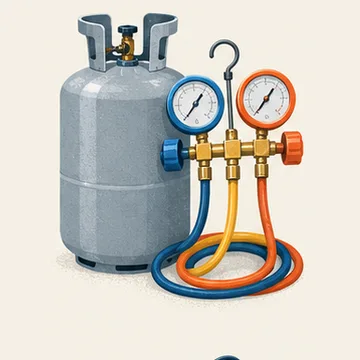
If your air conditioner or heat pump was installed before about 2010, there's a good chance it runs on R-22, the refrigerant once sold as Freon. R-22 damages the ozone layer, and the United States phased it out in steps. The last step came on January 1, 2020, when production and import of R-22 ended[1]. Your system didn't stop being legal that day. What changed is where the refrigerant for it comes from and what it costs.
How to tell if your system uses R-22
Look at the data plate on the outdoor unit. EPA notes that most air conditioners have a nameplate identifying the refrigerant[1], and Carrier says to look for "R-22" or "HCFC-22" on the outdoor unit's sticker[13]. While you're there, decode the serial number: most R-22 systems are well past 15 years old now, and age matters as much as refrigerant in what comes next.
R-22 is a strong but not perfect dating clue. Federal rules stopped virgin R-22 from being used to make new equipment from January 1, 2010[2]. Site-assembled systems that weren't pre-charged could still be filled with recycled R-22, and pre-2010 component inventory could still be sold[4], so some R-22 condensers went into homes after that date.
Can you keep running it?
Yes. EPA says you may continue to use an R-22 system for as long as you like, and that reclaimed R-22 and R-22 made before 2020 are meant to supply existing systems[1].
A sealed system doesn't use up refrigerant. If yours runs year after year without needing a charge, R-22 is not a problem for you until something breaks.
When it needs refrigerant
Needing refrigerant means there's a leak. EPA advises asking the technician to find and fix the leak rather than "topping off"[1], because a top-off on a leaking system just means paying again next summer.
The price per pound is the reason this matters. Carrier, citing Angi, puts R-22 at about $90 to $250 per pound in 2026[13], and This Old House lists $90 to $150 per pound installed against $50 to $80 for R-410A[14]. These are estimates and vary by region and supplier. A home system holds several pounds, so a recharge after a significant leak can run into four figures.
Supply comes from reclaimed refrigerant pulled out of retired systems. EPA data reported by ACHR News showed about 8 million pounds reclaimed per year around 2017 and 2018, and experts at the time didn't expect a near-term shortage[15]. Prices still reflect a product that can no longer be made.
You can't buy it yourself. Federal rules restrict R-22 sales to certified technicians[5], and anyone servicing a home central air system needs Type II or Universal certification[6]. The mandatory leak-repair deadlines in EPA's rules apply to systems holding 50 pounds or more[7], which leaves out nearly every house, so fixing the leak is your decision, not a legal requirement.
Avoid anything sold as "R-22a" or "22a." Despite the name it is a flammable hydrocarbon product, and EPA says it is not approved for home air conditioning[8].
Retrofit refrigerants
Some technicians offer to convert an R-22 system to a substitute refrigerant instead of refilling it with R-22. EPA says a retrofit should recover the remaining R-22 first, follow the substitute's guidelines, and come with an explanation of how it will affect performance and efficiency[1]. The common substitutes trade convenience against capacity:
| Refrigerant | Notes |
|---|---|
| R-438A (Freon MO99) | Works with the existing mineral oil and is nonflammable. Delivers about 5 to 10% less capacity than R-22. Not for topping off a system that still has R-22 in it[9]. |
| R-422D (Freon MO29) | About 8% less capacity in Chemours's comparison, with higher discharge pressure[10]. |
| R-407C | Calls for draining the old oil and switching to POE oil, and for a charge of about 90 to 95% of the R-22 weight[11]. |
A retrofit can make sense on a system that's otherwise in good shape. On a 20-year-old unit with a failing compressor, it usually doesn't: you'd be spending money to keep an old system running at lower capacity.
Why R-410A can't go in
R-410A runs at much higher pressures than R-22 and needs equipment and oil designed for it[12]. You can't add it to an R-22 system or swap one for the other. Carrier mentions that a conversion is possible only with major changes to the compressor and expansion valves[13], which in practice means new equipment. And R-410A itself is now being phased down: under the AIM Act, HFC production and consumption caps step down to 30% of baseline from 2029[16], and new home systems have moved on to lower-impact refrigerants.
- The outdoor unit decodes to 2006, so it's about 20 years old, beyond the 7-to-15-year range InterNACHI gives central air[17].
- The technician finds a leak at the indoor coil and quotes a coil repair plus 4 pounds of R-22.
- At $90 to $250 per pound, the refrigerant alone is roughly $360 to $1,000 before labor and parts.
- Spending that on a 20-year-old system rarely pays back. Getting replacement quotes now, before the next heat wave, is the usual call.
What changes when you replace an R-22 system
Replacing an R-22 system means replacing both halves. The outdoor condenser and the indoor coil are matched to a refrigerant and an oil, and new equipment uses different refrigerants and pressures. Expect the quote to cover:
- A new outdoor unit and a new indoor coil (or air handler) rated for the new refrigerant.
- The refrigerant lines. Some installers flush and reuse the existing line set if it's the right size and in good shape; others run new lines. Ask which, and why.
- Proper recovery of the old R-22. Knowingly venting refrigerant is illegal[1], and certified technicians recover it for reclaim.
- Possibly the furnace or air handler. A new coil has to fit the furnace cabinet, and an old furnace may be due anyway.
That makes an R-22 replacement a full system job. It's the main reason to start getting quotes while the old one still runs.
Common mistakes
- Paying for top-offs every summer. Fix the leak or plan the replacement.
- Buying "R-22a." It's a flammable product EPA has warned against.
- Mixing a retrofit refrigerant into leftover R-22. Chemours says it's not recommended[9].
- Assuming R-22 dates a unit to before 2010. Some were installed later.
- Replacing a working system out of panic. If it holds its charge, it can keep running.
Check the age and the cost
Decode the outdoor unit with the decoder, then compare a repair quote with the replacement prices in what an AC or heat pump replacement costs.
Frequently asked questions
Is it illegal to have an R-22 air conditioner?
No. EPA says you can keep using an R-22 system for as long as it works. What ended on January 1, 2020 was the production and import of new R-22.
Can I add R-410A to my R-22 system?
No. R-410A runs at much higher pressures and needs equipment and oil designed for it. Mixing refrigerants is also not recommended.
Can I buy R-22 myself and top off my system?
No. Federal rules limit R-22 sales to EPA-certified technicians, and home central air systems must be serviced by technicians with Type II or Universal certification.
What is R-22a? Can I use it?
R-22a is a flammable hydrocarbon product, not R-22. EPA has warned that it is not approved for home air conditioners.
How much does it cost to replace an R-22 system?
It's a full system replacement: outdoor unit, indoor coil and often the line set. National surveys put central AC replacement at roughly $3,000 to $13,500, with the higher figures for higher-efficiency equipment.
Get free local pricing on heating and cooling replacement
Comparing local prices is the easiest way to decide whether to repair or replace your heating and cooling system.
Call (213) 953-5723Free call. You will be asked for your 5-digit ZIP code, then connected to a local company. Stay on the line, because it can take a few seconds to connect. The company that answers is an independent partner, and this site may be paid a fee for the call. You are never obliged to hire anyone.
Sources
- U.S. EPA, Residential Air Conditioning and the Phaseout of HCFC-22: What You Need to Know (PDF)
- eCFR, 40 CFR 82.15, Prohibitions for class II substances
- U.S. EPA, Phaseout of Class II Ozone-Depleting Substances
- CSE Magazine, EPA issues refrigerant rules
- eCFR, 40 CFR 82.154, Prohibitions (refrigerant sales)
- eCFR, 40 CFR 82.161, Technician certification
- eCFR, 40 CFR 82.157, Appliance maintenance and leak repair
- U.S. EPA, Stationary refrigeration resources for homeowners
- Chemours, Freon MO99 (R-438A) FAQ (PDF, via First Supply)
- Chemours, R-22 replacement products comparison (PDF, via Crescent Parts)
- Arkema, Forane retrofit data sheet (PDF)
- ACHR News, R-410A: special handling is required
- Carrier, R-22 refrigerant
- This Old House, How much does Freon cost? (updated April 7, 2026)
- ACHR News, R-22 reclamation continues to slow down
- eCFR, 40 CFR part 84, Phasedown of hydrofluorocarbons
- InterNACHI, Standard Estimated Life Expectancy Chart for Homes
Keep a record of your home
The age you just looked up is the kind of fact that gets lost. A written record of serial numbers, install dates, repairs and who did the work saves the next owner, inspector or insurer from guessing.

Keep This With the House
A lifetime logbook for the house, organized by system, with room for serial numbers, install dates, repairs and contractors.

The House Has Old Pipes
Galvanized, polybutylene, cast iron and the sewer line: what fails, what it costs and how to decide.

The House Is Fifty Years Old
A buyer's guide to older homes: wiring, pipes, lead, asbestos, insurance refusals and what the repairs cost.
Book links are Amazon affiliate links.