
What an AC or heat pump replacement costs, and when repair still wins
Survey prices for new systems and common repairs, the rules that changed what can be installed, and repair-or-replace math.
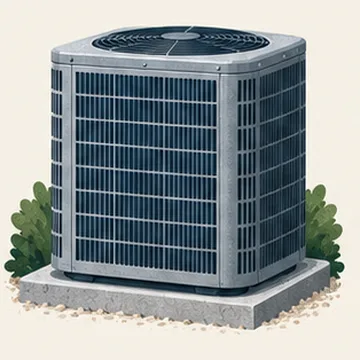
An air conditioner that quits in July gets replaced at July prices, by whoever can come first. One that's replaced in April, after a few quotes, usually costs less and fits the house better. This guide gives you the numbers to plan the April version.
Every figure here is an estimate from a manufacturer or a national cost survey. They disagree with each other, sometimes by a lot, so the useful thing is the range, not any single number.
What a new system costs
| System | Estimate | Source |
|---|---|---|
| Central AC, replacement | $6,958 to $13,418 typical; $3,900 to $13,500 overall | Trane, 2026[1] |
| Central AC, replacement | $3,000 to $7,500 | Sears Home Services, 2026[2] |
| Air-source heat pump | $5,000 to $15,000; average $8,350 | Fixr, 2026[3] |
| Air-source heat pump | $6,000 to $25,000 | Carrier, 2026[4] |
| Furnace and AC together | $6,000 to $22,000; average $10,500 | PickHVAC, May 2026[5] |
Trane's range runs well above Sears's. Part of that is equipment tier: a variable-speed, high-SEER2 system costs far more than a single-stage unit at the federal minimum. Trane lists brand, tonnage, SEER2 rating, staging and local labor as the main drivers[1]. Fixr ties heat pump cost to home size, from about $5,000 to $8,000 for a 2-ton unit serving 1,000 square feet up to $8,000 to $20,000 for 3 to 4 tons serving 2,000[3].
The add-ons
PickHVAC breaks out the extras that separate a cheap quote from a complete one[5]:
- Refrigerant line set: $300 to $1,200
- Refrigerant recovery or recharge: $150 to $400
- Permits: $50 to $800
- Disposal of the old equipment: $75 to $300
- Ductwork beyond about 50 feet: $1,000 to $5,000
Carrier adds that older homes may need new wiring or an electrical upgrade for a heat pump, and leaky or undersized ducts can drag down any new system[4].
What common repairs cost
| Repair | Fixr, July 2026[6] |
|---|---|
| Capacitor | $100 to $400 |
| Contactor | $150 to $400 |
| Condenser fan motor | $200 to $700 |
| Refrigerant leak repair and recharge | $200 to $1,600 |
| Evaporator coil | $600 to $2,000 |
| Compressor | $800 to $2,800, sometimes over $3,000 |
Sears puts a compressor job at $1,500 to $3,000 all in[2]. A capacitor or contactor on a 6-year-old unit is a routine fix. A compressor on a 13-year-old unit is the classic replace signal.
Repair or replace: the math
The $5,000 rule multiplies the system's age by the repair quote; over $5,000 favors replacement. CBS News gives the example of a 12-year-old system with a $500 repair: $6,000, so replace[7]. Fixr also uses a 50% rule, replacing when the repair costs more than half a new system[6]. Neither rule has a known author. They are prompts, not verdicts.
- $5,000 rule: 11 × $2,200 = $24,200. Far over.
- 50% rule: against an $8,350 average heat pump install, $2,200 is about 26%. Under.
- InterNACHI gives heat pumps 10 to 15 years[15], so this one is already inside its likely end-of-life window.
- A new compressor in an 11-year-old cabinet still leaves an 11-year-old coil, fan motor and controls. Most owners in this spot replace.
The 2025 refrigerant change
Under EPA's Technology Transitions rule, new residential AC and heat pump systems must use refrigerants with a global warming potential below 700. R-410A, the standard for the past 15 years, is rated 2,088, so new systems now use alternatives such as R-454B or R-32, which are rated mildly flammable (A2L)[10]. New R-410A systems couldn't be made or imported from January 1, 2025[11].
Two practical points for homeowners:
- Existing R-410A systems can still be repaired. EPA keeps parts available, and a failed outdoor unit can be replaced without replacing the whole system. Replacing the indoor coil too, now or later, makes it a new system that has to meet the new refrigerant limit[11].
- Older R-410A stock can still be installed. A rule that took effect July 27, 2026 removed the January 1, 2026 deadline for installing systems built entirely from components made before 2025[11][12]. Commenters warned that R-410A for recharges may get pricier and scarcer as the phasedown continues[11].
Minimum efficiency by region
Since January 1, 2023 the national minimum for a split-system air conditioner is 13.4 SEER2, and for a split heat pump 14.3 SEER2 and 7.5 HSPF2[8]. Southern states set a higher bar for split AC: 14.3 SEER2 under 45,000 Btu/h and 13.8 above it, plus EER2 minimums in the Southwest[8]. The Southeast covers states from Texas and Oklahoma east through Florida and up to Delaware and Maryland, plus Hawaii and D.C.; the Southwest is Arizona, California, Nevada and New Mexico[8]. In those regions the rule follows the install date, not the manufacture date[9].
Tax credits
The federal 25C credit, which covered up to $2,000 for a heat pump and $600 for central AC[16], does not apply to equipment placed in service after December 31, 2025[13]. The install date controls; paying a deposit in 2025 doesn't save it[14]. Utility rebates and state programs may still help, so ask your installer and check your utility's site.
How to compare quotes
Two quotes for "a 3-ton system" can describe very different jobs. Before you compare totals, line them up on the same points:
- Exact model numbers for every piece: outdoor unit, indoor coil or air handler, and furnace if it's included. A matched indoor and outdoor pair is what the efficiency rating assumes.
- Refrigerant. Is it R-454B or R-32 equipment, or older R-410A stock? Ask how parts and refrigerant will be supplied for whichever it is.
- Line set. Is the contractor reusing the old refrigerant lines or running new ones, and why?
- Load calculation. Did anyone measure the house, or is the new unit simply the same size as the old one? An oversized system short-cycles and dehumidifies poorly.
- Permit, disposal, pad and electrical work. Included or extra?
- Warranty. Parts and labor, how long, and whether registration is required.
A quote that names every model and answers each of these is worth more than a cheaper one that doesn't. When two quotes differ by thousands, the difference is almost always in this list.
Common mistakes
- Counting on a 2026 federal tax credit. It ended with 2025 installs.
- Comparing quotes without the add-ons. Line sets, permits and duct work change the total by thousands.
- Replacing only the outdoor unit on an old system. A mismatched pair can lower efficiency and bring more repairs.
- Assuming R-410A systems can't be repaired. They can.
- Deciding on price alone. A unit that's the wrong size costs more to run every summer.
Start with the age
Read the outdoor unit's serial with the decoder, or see how to tell how old your AC or heat pump is.
Frequently asked questions
Can my R-410A air conditioner still be repaired?
Yes. EPA's rules keep parts available for existing R-410A systems, and a failed outdoor unit can be replaced on its own. Replacing the indoor coil and outdoor unit together counts as a new system, which has to use a lower-impact refrigerant.
Can contractors still install new R-410A systems?
Only if every component was made or imported before January 1, 2025. EPA removed the January 1, 2026 installation deadline for that older stock in a rule that took effect July 27, 2026. Some states, such as New York, keep their own deadlines.
What is the minimum efficiency for a new AC in Texas or Florida?
A split-system air conditioner under 45,000 Btu/h installed in the Southeast must reach 14.3 SEER2. Larger units need 13.8 SEER2. The national floor elsewhere is 13.4 SEER2.
Is there a federal tax credit for a heat pump in 2026?
No. The 25C credit ended for equipment placed in service after December 31, 2025. The install date controls, not the payment date.
How long does an AC or heat pump last?
InterNACHI gives central air conditioners 7 to 15 years and heat pumps 10 to 15. Heat pumps that heat and cool all year tend to land at the shorter end.
Get free local pricing on heating and cooling replacement
Comparing local prices is the easiest way to decide whether to repair or replace your heating and cooling system.
Call (213) 953-5723Free call. You will be asked for your 5-digit ZIP code, then connected to a local company. Stay on the line, because it can take a few seconds to connect. The company that answers is an independent partner, and this site may be paid a fee for the call. You are never obliged to hire anyone.
Sources
- Trane, AC replacement cost
- Sears Home Services, Cost to replace an air conditioner in 2026 (February 11, 2026)
- Fixr, Heat pump installation cost (updated January 22, 2026)
- Carrier, How much does a heat pump cost?
- PickHVAC, Furnace and AC replacement cost (May 22, 2026)
- Fixr, AC repair cost (July 31, 2026)
- CBS News, What is the $5,000 rule for HVAC systems? (June 24, 2026)
- eCFR, 10 CFR 430.32, Energy and water conservation standards
- International Code Council, 2023 efficiency requirements for air conditioning systems
- Rheem, 2024 A2L regulatory guide (PDF)
- Federal Register public inspection, EPA HFC Technology Transitions reconsideration, FR Doc. 2026-10387 (PDF)
- ACCA, EPA lifts R-410A installation deadline (May 22, 2026)
- 26 U.S. Code section 25C (Cornell LII)
- IRS, Energy credits FAQs (FS-2025-05)
- InterNACHI, Standard Estimated Life Expectancy Chart for Homes
- IRS, Energy Efficient Home Improvement Credit
Keep a record of your home
The age you just looked up is the kind of fact that gets lost. A written record of serial numbers, install dates, repairs and who did the work saves the next owner, inspector or insurer from guessing.

Keep This With the House
A lifetime logbook for the house, organized by system, with room for serial numbers, install dates, repairs and contractors.

The House Has Old Pipes
Galvanized, polybutylene, cast iron and the sewer line: what fails, what it costs and how to decide.

The House Is Fifty Years Old
A buyer's guide to older homes: wiring, pipes, lead, asbestos, insurance refusals and what the repairs cost.
Book links are Amazon affiliate links.