
How to flush a water heater
Drain the sediment once a year and refill before the power goes back on.
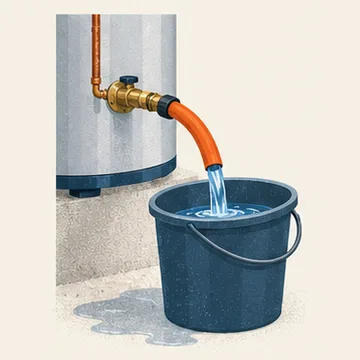
Tap water carries dissolved minerals, and heating it drops some of them out. They settle on the bottom of the tank as a layer of sediment. On a gas tank the layer sits between the flame and the water, so the burner works harder and the bottom runs hotter. On an electric tank it buries the lower element. A.O. Smith says draining it out extends the life of the tank, the elements and the drain valve, and that skipping it can cause damage and leaks[1].
How often
A.O. Smith's schedule is a first flush at 6 months, then at least once a year[1]. Rheem says once a year for most homes, every 6 months with hard water, and more often if you see sediment[2]. New York's housing agency puts a yearly flush on its maintenance schedule for electric water heaters[3].
If you've never flushed a tank that's 10 or more years old, read the warning further down before you start.
What you need
- A garden hose long enough to reach a floor drain, a utility sink or the outdoors, running downhill the whole way[5]
- A bucket and a towel
- A flathead screwdriver, if the drain valve has a slotted stem
- Gloves; the first water out can still be hot
Step by step
This follows A.O. Smith's procedure for an electric tank[1], with the gas-tank differences from Bradford White's manual[4].
- Turn off the heat source. Electric: switch off the breaker. Gas: turn the gas control knob to OFF[4].
- Let the water cool. Run a hot tap until the water is no longer hot[1], or wait a few hours.
- Connect the hose to the drain valve at the bottom of the tank and run it to your drain.
- Shut off the cold water supply to the tank.
- Open the drain valve.
- Open a hot faucet somewhere in the house. This lets air in so the tank drains instead of holding a vacuum[1].
- Stir up the sediment. When the tank is nearly empty, open the cold supply for short bursts with the drain still open. The rush of water lifts sediment off the bottom. Repeat until the water runs clear[1].
- Close the drain valve and remove the hose.
- Refill completely. Open the cold supply with the hot faucet still open. When water flows steadily from the faucet, let it run at least 3 more minutes to push the air out[1].
- Turn the heat back on. Breaker on, or relight the gas following the lighting label on the tank[4]. Reheating a full tank can take an hour or more[1].
- The first gallons come out cloudy, with white or tan grit. That's normal.
- Two or three stir-and-drain rounds usually bring it clear.
- If the drain slows to a trickle, sediment is blocking the valve. See the next section.
- After the refill, the popping on burner start-up is quieter or gone.
If the drain clogs or won't drain
A slow or stopped drain is usually one of three things. HomeTips suggests these fixes[5]:
- A vacuum. Make sure a hot faucet is open. Lifting the relief valve lever briefly also lets air in, but an old relief valve may not seal again afterward, so the hot faucet is the gentler choice.
- Sediment in the valve. Step on the hose and release it to pulse the flow, or turn the cold supply on for a few seconds to push water out under pressure.
- A clogged valve. A double-female hose fitting lets you back-flush the valve from a faucet. If it clogs every time, replace the valve.
Many tanks ship with a plastic drain valve. Don't overtighten it; plastic valves crack[5]. Some A.O. Smith models come with a brass quarter-turn ball valve instead[6], which drains faster and clogs less.
If the sediment has hardened into lumps that won't drain at all, A.O. Smith recommends having a qualified person use a deliming product that is safe for potable water[1].
Electric tanks: check the elements
With the tank drained is a good time to look at the heating elements. A.O. Smith notes that in hard water, replacing lime-crusted elements is usually cheaper than trying to clean them[1].
A warning about old, never-flushed tanks
On a tank that's 10 or more years old and has never been flushed, sediment may be packed against weak spots in the bottom. Disturbing it can expose a leak that was already there[5]. That's not a reason to skip maintenance, but have a plan: a drain pan under the tank, a leak alarm, and a replacement price in hand. Check the age with the decoder first.
Replacing a leaking or clogged drain valve
A drain valve that drips after you close it, or clogs on every flush, is worth replacing while the tank is empty anyway. Most are threaded into the tank and unscrew counter-clockwise. Wrap the new valve's threads with sealant tape, thread it in by hand, then snug it without forcing a plastic one[5]. A brass full-port or ball-style valve drains faster and is less likely to clog. Refill and check for drips before turning the heat back on.
If the old valve won't stop dripping and you can't replace it right away, a brass hose cap on its outlet will hold the drip until you can.
Relighting a gas water heater
Every gas water heater has lighting instructions printed on a label on the tank, and Bradford White's manual says to follow them after the tank is refilled[4]. Many newer tanks have electronic ignition that lights on its own once the control is turned back on. Older ones have a pilot you light with a built-in igniter button. If you smell gas at any point, stop, leave the house and call the gas company from outside.
Common mistakes
- Restoring power before the tank is full. Dry firing destroys the element at once, and the warranty doesn't cover it[1].
- Draining scalding water. Let it cool first.
- Forgetting to open a hot tap. The tank holds a vacuum and barely drains.
- Running the hose uphill. It has to fall the whole way to the drain.
- Cranking a plastic drain valve shut. It cracks and leaks.
Tankless heaters are different
A tankless water heater has no tank to collect sediment. Instead, scale builds up inside the heat exchanger and has to be dissolved with a pump and a descaling solution. See how to descale a tankless water heater.
Frequently asked questions
How often should I flush my water heater?
Rheem says once a year for most homes and every 6 months with hard water. A.O. Smith says after the first 6 months and at least yearly after that.
Do I have to turn off the power or gas first?
Yes. Switch off the breaker for an electric tank, or turn the gas control to OFF on a gas tank, before you drain anything.
Why won't my water heater drain?
Usually a vacuum or sediment in the valve. Open a hot faucet to let air in, keep the hose running downhill, and briefly turn the cold supply on to push sediment through.
What happens if I turn the power on before the tank is full?
On an electric tank the upper element burns out almost immediately. A.O. Smith calls this dry firing and says the warranty doesn't cover it.
Sources
- A.O. Smith, Use and Care Guide, electric water heater (March 2026, PDF)
- Rheem, How often to flush your water heater and how to do it (May 29, 2026)
- New York State Homes and Community Renewal, maintenance recommendation for electric water heaters
- Bradford White, gas water heater service manual 238-51542-00C (PDF)
- HomeTips, How to flush a water heater
- A.O. Smith, RE50800 specification sheet (PDF)
- A.O. Smith, gas water heater installation and operation manual (PDF)
Keep a record of your home
The age you just looked up is the kind of fact that gets lost. A written record of serial numbers, install dates, repairs and who did the work saves the next owner, inspector or insurer from guessing.

Keep This With the House
A lifetime logbook for the house, organized by system, with room for serial numbers, install dates, repairs and contractors.

The House Has Old Pipes
Galvanized, polybutylene, cast iron and the sewer line: what fails, what it costs and how to decide.

The House Is Fifty Years Old
A buyer's guide to older homes: wiring, pipes, lead, asbestos, insurance refusals and what the repairs cost.
Book links are Amazon affiliate links.