
How to check and replace a water heater anode rod
The cheapest part on a tank water heater, and the one that decides when the tank rusts.
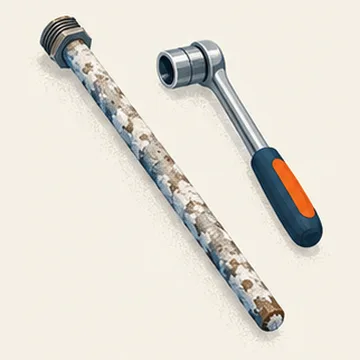
Inside nearly every glass-lined steel water heater hangs a metal rod whose only job is to corrode. A.O. Smith calls it the tank's "first line of defense" against corrosion and leaks[1]. As long as the rod has metal left to give, the water attacks it instead of the steel tank. When it's used up, the tank is next.
That makes the anode the best maintenance bargain in the house. A replacement rod costs tens of dollars, and a plumber typically charges $50 to $150 to swap it[7]. A new tank costs well over a thousand.
The kinds of anode
- Magnesium. The most common. It protects aggressively and wears out faster, especially with softened water.
- Aluminum or aluminum-zinc. Lasts longer in hard water. Zinc-alloy rods are the usual fix for sulfur smells, and A.O. Smith's guide lists a zinc anode as one remedy[1].
- Powered anode. A titanium electrode fed by a small plug-in rectifier. It doesn't get used up and probably cures sulfur odor, but check with the tank's maker about the warranty before installing one[6].
- Combination anode. Built into the hot-water outlet nipple instead of having its own port. Bradford White uses this design on some gas models; you disconnect the hot outlet piping to remove it[3].
When to check it
The first inspection is due 6 months after installation, then at least once a year, and more often with a water softener, since softened water eats the rod faster[1]. Rheem recommends a yearly check and says it "can add years" to the heater's life[2]. Green Building Advisor notes that in some water an anode can be gone in as little as 6 months[5].
Replace it when it's worn to about half its original diameter, around 5/8 inch, or when any of the steel core wire shows[3]. Rheem also says to replace one that's heavily coated in calcium[2], because a crusted rod can't do its job.
What you need
- A 1-1/16 inch six-point socket[1]
- A 1/2-inch drive breaker bar; a length of steel pipe over the handle adds leverage[5]
- Thread sealant tape or approved pipe sealant[1]
- A garden hose for draining, and a bucket
- A replacement anode of the right length, or a segmented one for tight spaces
- Someone to hold the tank steady while you break the rod loose
Factory anodes are tight. A.O. Smith's guide mentions an impact wrench rated for 1,400 ft-lb of breakaway torque[1], which tells you how much force it can take. Don't let the tank twist on its connections while you lean on the bar.
Step by step
These steps follow A.O. Smith's procedure for an electric tank[1]. On a gas tank, turn the gas control knob to OFF instead of switching off the breaker[3].
- Cut the power. Switch off the breaker for an electric tank, or turn the gas control to OFF.
- Let the water cool. Run a hot tap until the water is no longer hot, to avoid scalding[1].
- Shut off the cold water supply to the tank.
- Relieve the pressure. Open a hot tap somewhere in the house.
- Drain a few gallons, at least 5 per the A.O. Smith guide, so the water level sits below the anode port[1]. For a combination anode on the hot outlet, drain below the outlet nipple[3].
- Uncover the anode. On many tanks it's under a plastic cap and a plug of insulation on top.
- Break it loose. Seat the six-point socket fully on the hex and turn counter-clockwise.
- Pull it and look. Compare it with the replacement rule above.
- Install the new rod. Wrap the threads with sealant tape, start it by hand, then snug it with the socket[1].
- Refill before you power up. Open the cold supply with a hot tap open, and let water run steadily from that tap for 3 minutes before restoring power[1]. Powering an electric tank that isn't full burns out the upper element.
- Check for leaks at the anode port.
Low ceiling? Use a segmented rod
A standard anode is as long as the tank is tall, so pulling one straight up needs that much clearance above the tank. Segmented, or link, anodes bend at the joints and feed in through a small gap. Bradford White sells a 50-inch segmented magnesium rod for this, part 415-55482-00[4].
- The serial decodes to 2018. In October 2026 the tank is about 8 years old.
- The house has a water softener, which wears anodes down faster.
- The rod comes out as a bare wire with a few lumps. It's done.
- A new rod now protects the steel again. The tank has passed the point where the lining was guarded, so it may already have some corrosion, but the swap gives it a real chance at reaching 12 or more.
The rotten-egg smell
Sulfur-smelling hot water usually comes from harmless bacteria reacting with the anode. Chlorinating the water is the only sure cure, according to A.O. Smith. A zinc anode may help, and raising the tank to 140°F can reduce the bacteria[1], though that temperature scalds quickly, so use a mixing valve or turn it back down. Pulling the anode out entirely also stops the smell, and voids the warranty, because the tank must have an anode installed at all times[1].
Warranty notes
Anodes are consumable parts and aren't covered by A.O. Smith's warranty[1]. Running a tank without one voids it[1]. If your tank is still under warranty, read the terms before switching to a powered anode.
Common mistakes
- Using a 12-point socket. It rounds the hex. Use six-point.
- Not draining enough. Water pours out of the port when the rod comes free.
- Restoring power to an empty electric tank. The upper element burns out instantly.
- Looking for a hex on top of a Bradford White. Some use a combination anode on the hot outlet.
- Leaving the anode out to stop odor. It voids the warranty and speeds up tank corrosion.
Is the tank worth it?
A new anode makes sense on a tank with years left. On one past 12, the money may be better saved toward a replacement. Check the build date with the decoder first.
Frequently asked questions
What size socket fits a water heater anode rod?
A 1-1/16 inch six-point socket. A.O. Smith specifies six-point and warns that a socket not fully seated can strip the hex head.
How often should I check the anode rod?
A.O. Smith says after the first 6 months and then at least once a year, more often if you have a water softener. Rheem recommends a yearly check.
When does the anode rod need replacing?
Bradford White's service manual says when it's worn to half its original diameter (about 5/8 inch) or when any of the steel core wire shows.
Can I just remove the anode to stop the rotten-egg smell?
Don't. A.O. Smith says an anode must be installed at all times or the warranty is void, and the tank will corrode faster. Try a zinc-alloy anode instead.
Does a new anode rod make an old tank last longer?
Only if the tank hasn't already started corroding. On a tank under about 8 years old, a timely replacement can add years. On one past 12, the steel may already be compromised.
Can I install a longer or thicker anode than the original?
Usually you can install a rod of the same thread and length in a different alloy. Check the tank's manual; some makers specify which anodes keep the warranty valid.
Sources
- A.O. Smith, Use and Care Guide, electric water heater (March 2026, PDF)
- Rheem, How to keep your tank and tankless water heaters running at peak performance (December 22, 2025)
- Bradford White, gas water heater service manual 238-51542-00C (PDF)
- SupplyHouse, Bradford White 415-55482-00 segmented magnesium anode
- Green Building Advisor, The secret to making your water heater last decades (September 4, 2025)
- Water Heater Rescue, Powered anode FAQ
- HomeAdvisor, Water heater repair cost (updated June 17, 2026; estimates)
Keep a record of your home
The age you just looked up is the kind of fact that gets lost. A written record of serial numbers, install dates, repairs and who did the work saves the next owner, inspector or insurer from guessing.

Keep This With the House
A lifetime logbook for the house, organized by system, with room for serial numbers, install dates, repairs and contractors.

The House Has Old Pipes
Galvanized, polybutylene, cast iron and the sewer line: what fails, what it costs and how to decide.

The House Is Fifty Years Old
A buyer's guide to older homes: wiring, pipes, lead, asbestos, insurance refusals and what the repairs cost.
Book links are Amazon affiliate links.