
How to descale a tankless water heater
A pump, a bucket and a few gallons of vinegar, once a year, keeps scale out of the heat exchanger.
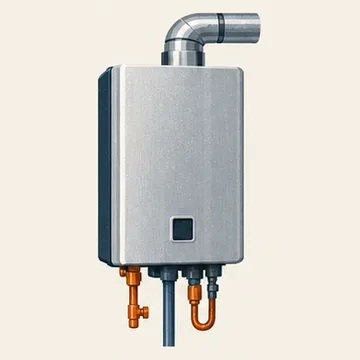
A tankless water heater has no tank to rust out, which is why it can last much longer than a tank. Its weak point is the heat exchanger, a coil of narrow passages that heats water on its way through. Hard water is mostly dissolved calcium and magnesium, and heating it drops calcium carbonate out as scale[1]. In a tankless unit, that scale lines the heat exchanger, chokes the flow and makes the unit overheat.
Descaling dissolves it. It takes about an hour and a half and a few inexpensive tools, and every major maker tells owners to do it.
Is your water hard?
The U.S. Geological Survey calls water with 61 to 120 mg/L of hardness moderately hard, 121 to 180 hard, and over 180 very hard[1]. Your water utility's annual quality report lists the number. Rinnai and Navien both set 200 mg/L (about 12 grains per gallon) as the upper limit for their units[2][4], and Navien says water above 12 grains needs a softener or scale-prevention system[4].
How often
- Rheem: clean the inlet filter and flush the heat exchanger at least once a year[7].
- Navien: once a year for residential units in moderate to very hard water[4]. Some models can show a reminder at 6, 12 or 24 months[4].
- Rinnai: at least once a year, according to its owner page[8]. In hard-water areas, the manual says to treat the water, flush regularly, or both, and an installer can set an optional service reminder[2].
Scale forms faster at higher temperature settings[2], so a unit set to 140°F needs flushing more often than one at 120°F.
What you need
- Isolation (service) valves on the hot and cold lines at the unit. Rinnai strongly recommends them[2], and most installers fit them as a set with hose ports.
- A small submersible pump
- Two or three washing-machine-style hoses
- A 5-gallon bucket[3]
- 3 to 4 gallons of undiluted food-grade white vinegar[2][5], or a descaler made for tankless heaters[4]
Step by step
This is the general sequence from the Rinnai, Navien and Noritz manuals. Follow your own model's manual where it differs.
- Turn off the unit and the gas. Rinnai's procedure starts with the gas off[2]. Disconnect electrical power too.
- Close the hot and cold isolation valves.
- Relieve pressure by slowly opening the purge ports on the valves. Have a towel ready.
- Connect the hoses. One runs from the pump outlet to the cold-side service port. Another runs from the hot-side port back into the bucket.
- Fill the bucket with the vinegar or descaler and set the pump in it.
- Open both service ports and run the pump. Circulate at least 45 minutes for Navien[3] and at least an hour for Rinnai and Noritz[2][5]. Noritz suggests swapping in fresh solution after 30 minutes for best results[5]. Some Rinnai models have a descale mode that counts down from 60[2].
- Rinse. Close the cold service port, open the cold isolation valve, and let fresh water run out through the hot-side hose for at least 5 minutes[2][3]. Noritz says 5 minutes or 20 gallons[5].
- Clean the inlet filter. Rinnai and Navien both say to clean the cold-water inlet filter screen at the end[2][3].
- Restore everything. Close the service ports, remove the hoses, open both isolation valves, then restore power and gas. Run a hot tap until the flow is steady.
Order matters in the rinse: closing the service port before opening the cold supply keeps fresh water from pushing back into your bucket and pump.
- The display shows LC. Rinnai's manual says this means the unit is starting to scale up and must be flushed[2].
- The homeowner circulates 4 gallons of white vinegar for an hour at the unit's service ports, then rinses for 5 minutes.
- The inlet filter screen is cleaned and the unit restarted. The code clears.
- Local water tests at 190 mg/L, very hard on the USGS scale, so the next flush goes on the calendar for 6 months out.
Codes that point to scale
- Rinnai LC: scale buildup; flush the unit[2].
- Navien E016 and E030: heat exchanger overheating and exhaust overheating. Navien lists flushing the heat exchanger among the fixes for both[3].
- Noritz: a code 11 shown after descaling is usually cleared by power-cycling the unit[5].
Navien also notes that a clogged intake air filter causes an E110 code and should be cleaned every 3 to 4 months[3]. That one is an air problem, not scale.
Warranty
Rinnai says damage from scale isn't covered[2]. Navien excludes damage caused by poor water quality[4]. Noritz excludes damage from water harder than 12 grains per gallon and damage when a scale code was shown and the unit wasn't flushed[6]. Keeping a dated note each time you descale is cheap insurance.
Preventing scale
Descaling treats the buildup. Water treatment slows it down. Navien says water above 12 grains per gallon of hardness needs a softener or a scale-prevention system ahead of the unit, and to check local codes about softeners[4]. Two common approaches:
- A whole-house softener swaps calcium and magnesium for sodium or potassium. It also helps fixtures and the rest of the plumbing, but costs more and needs salt.
- A scale-inhibitor cartridge on the cold line to the heater slowly releases a treatment meant to keep minerals from sticking. It's cheaper and only protects the heater.
Lowering the set temperature helps too, since scale forms faster in hotter water[2]. Whatever you choose, keep descaling on schedule; treatment reduces the buildup but rarely stops it completely.
Common mistakes
- Skipping the inlet filter. A clogged screen cuts flow even with a clean heat exchanger.
- Ignoring a scale code. Noritz's warranty specifically excludes it.
- Opening the cold supply before closing the service port. Water backs into the bucket.
- Leaving the gas on. Shut it off first.
- Running a high temperature in hard water. It speeds up scale.
How old is the unit?
A 15-year-old tankless heater that has never been descaled may be near the end of its heat exchanger's life. Decode the serial with the decoder and compare it with how long tankless heaters last. If you have a tank-style heater instead, see how to flush a water heater.
Frequently asked questions
How often should I descale a tankless water heater?
At least once a year, per Rheem and Navien. Rheem suggests about every 6 months in hard water, and Rinnai says hard-water homes must treat the water or flush regularly.
How much vinegar do I need?
Rinnai calls for 4 gallons of undiluted food-grade white vinegar. Noritz says 3 to 4 gallons.
How long should the solution circulate?
At least 45 minutes for Navien, and at least an hour for Rinnai and Noritz.
What does the Rinnai LC code mean?
Rinnai's manual says an LC code means the unit is starting to scale up and needs to be flushed.
Will skipping descaling void my warranty?
It can affect it. Rinnai, Navien and Noritz all exclude damage from scale or poor water quality.
Do I need isolation valves to descale?
For the pump-and-bucket method, yes. Rinnai strongly recommends them. If your unit has none, a plumber can add a valve kit, which also makes every future flush faster.
Sources
- U.S. Geological Survey, Hardness of water
- Rinnai, CX series installation and operation manual (PDF, via Lowe's)
- Navien, NPE-A2/S2 user's information manual
- Navien, NPE-A/S installation manual
- Noritz, How to descale a Noritz tankless water heater
- Noritz, Descale procedure and warranty notes (PDF)
- Rheem, How to keep your tank and tankless water heaters running at peak performance (December 22, 2025)
- Rinnai, Flushing my Rinnai tankless water heater
Keep a record of your home
The age you just looked up is the kind of fact that gets lost. A written record of serial numbers, install dates, repairs and who did the work saves the next owner, inspector or insurer from guessing.

Keep This With the House
A lifetime logbook for the house, organized by system, with room for serial numbers, install dates, repairs and contractors.

The House Has Old Pipes
Galvanized, polybutylene, cast iron and the sewer line: what fails, what it costs and how to decide.

The House Is Fifty Years Old
A buyer's guide to older homes: wiring, pipes, lead, asbestos, insurance refusals and what the repairs cost.
Book links are Amazon affiliate links.